Seconday Sunday of Easter

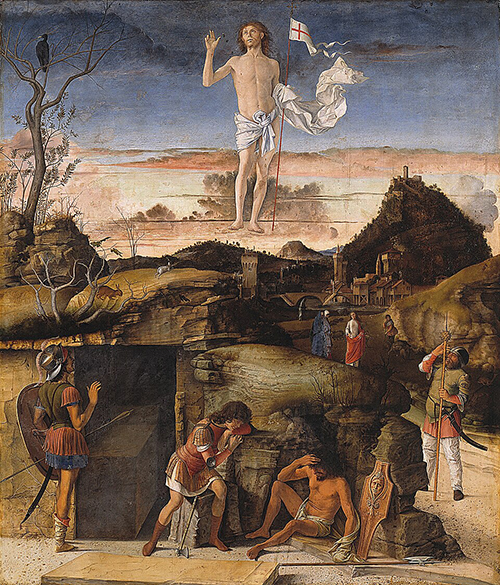
A perusal of Western religious art depicting the Resurrection of Jesus reveals a consistent pattern — Jesus is painted as going out and up. Some works indeed almost mirror the Ascension.

The art of the Orthodox tradition of Christian spirituality is the opposite. Within frescos and mosaics, the movement of Jesus is downward.

Within the Apostles’ Creed we pray that truth: “He suffered under Pontius Pilate, was crucified, died, and was buried; he descended to hell. The third day he rose again from the dead.”

One of the most famous depictions of this “downward” movement is the Anastasis, painted in the apse of the funeral chapel of the Church of the Holy Saviour (usually known simply as Chora) in present-day Istanbul.

First built in the 4th century, the Chora Church has been transformed through history into different functions, adapting to the political climate of Istanbul.

At the centre of the fresco stands a radiant, resurrected Christ. He stands on two broken gates of hell, with keys and locks festooned about them.

Flanking Christ are two sarcophagi, from which he draws Adam and Eve. He extends his hand in grace, pulling them — and by extension all of humanity — from the tomb.

On this second Sunday of Easter, known as Divine Mercy Sunday, the fresco from the church at Chora may provide a meditation around the theme: “I will come to you in your place of need and lift you out of that place.” Does that sound like mercy at all?

Resurrection of Christ is a painting by the Italian Renaissance artist Giovanni Bellini and is held at the Gemäldegalerie, Berlin.

The Anastasis fresco is part of a number of frescos found in the Church of the Holy Saviour at Chora, Istanbul.

Easter Sunday

To know that the author JRR Tolkien was a devout Catholic changes the way we read his body of work. He himself acknowledged the influence his Catholic faith had on his writing.

In the third book of Tolkien’s Lord of the Rings trilogy, there is a scene that captures something of the joy experienced by the disciples when the resurrected Jesus appeared to them.

The realm of the Dark Lord, Sauron, has been destroyed, and against all hope the world has been saved, at least for the time being. Frodo, the hobbit, and his faithful servant and friend, Samwise, have also been saved.

Sam wakes up, smells wonderful perfumes and sees Gandalf, the wizard he thought was dead. Sam gasps, “Gandalf! I thought you were dead! But then I thought I was dead myself. Is everything sad going to come untrue?”

“A great Shadow has departed,” said Gandalf, and then he laughed, and the sound was like music, or like water in a parched land; and as he listened the thought came to Sam that he had not heard laughter, the pure sound of merriment, for days upon days without count. It fell upon his ears like the echo of all the joys he had ever known.

But he himself burst into tears. Then, as sweet rain will pass down a wind of spring and the sun will shine out the clearer, his tears ceased, and his laughter welled up, and laughing he sprang from his bed.

“How do you feel?” he cried. “Well, I don’t know how to say it. I feel, I feel” – he waved his arms in the air – “I feel like the spring after winter, and the sun on the leaves; and like trumpets and harps and all the songs I have ever heard!”

Feast of the Body and Blood of Christ

Is it by chance that we celebrate the feast of the Body and Blood of Christ on the Sunday immediately following the feast of the Trinity? Or maybe there is something more to it?

There is a famous icon written by the Russian iconographer Andrei Rublev. It is known as the icon of the Trinity. The icon’s original title was, and in fact still is, known as “The Hospitality of Abraham” and was written in 1411. The story of Abraham and Sarah’s generous hospitality to three visitors who came to them by the oaks of Mamre is told in Genesis 18.

An examination of this icon suggests (to me at least) that there is an intimate relationship between the Trinity and Eucharist. As the icon is written the three persons are seated around a table in an attitude of harmony and peace; the very lines of the icon create a circle within which the unity of the persons, the manner of their presence to one another, is visible. At the focal point of the icon there is a cup between them on the table. It is a wonderful use of symbol and suggestion. The Trinity hints at the Eucharist. It is as if the divine persons were saying: be one with one another as we are one. (See John 17:21) To make the invitation even clearer, there is an empty place at the table.

We are being invited and drawn into the inner life of the Trinity, to sit at that empty place at God’s table. Jesus is the way; the Spirit is the inner urge to move that way. “No one can come to the Father unless the Father draw them” (Jn 6:44). Commenting on this in the fifth century, St Augustine wrote: “He did not say lead, but draw. This ‘violence’ is done to the heart, not to the body…. Believe and you come; love and you are drawn”.

Trinity Sunday

Have you ever gone for a walk early in the morning and noticed the leaves and flowers with a gentle covering of moisture on them? I am sure it didn’t rain during the night!

Or, you have been for a walk along the beach on an early summer morning and paused to sit awhile and need to wipe a gentle layer of dampness off the seat?

In the forest of early morning, there is the sound of a persistent drip!

It is called dewfall.

Each evening, the earth cools, and the moisture in the atmosphere transforms into condensation, forming the dew that will cover the ground,

The dew manages to reach each and every blade of grass, piece of clover, twig, sleeping caterpillar, car, and item left out on the clothesline, dead leaf, bottle cap, pebble and furled up fern that happens to be outdoors — every single one, for miles and miles.  All those tiny drops!  If it’s there, the dew is going to cover it.

In lands prone to aridity, the morning dew is a vital gift for the agricultural cycle, especially in the hot summer months. For them, it stood for cleansing, renewal and regeneration.

In our Scriptures, “like the dewfall” is a powerful image. We find it in psalms and prophecies and prayers of blessing.

In the prophet Hosea, we read, “God spoke through Hosea: “I will heal their defection, I will love them freely; for my wrath is turned away from them. I will be like the dew for Israel: He shall blossom like the lily” (Hos. 14:5-6).

In Eucharistic Prayer II, at the moment known as “The Epiclesis”, the presider prayers:

“Make holy, therefore, these gifts, we pray, by sending down your Spirit upon them like the dewfall.”

Traditionally we have strong, powerful images for the Holy Spirit and for Pentecost, eg wind and tongues of fire.

This Pentecost, I invite into an alternate image of the Holy Spirit – dewfall.

The Spirit, as the dewfall, arrives in a very quiet, unseen, mysterious unobtrusive, indiscriminate, and gentle way, Like the natural dew, the Spirit reaches everywhere, everything, and everyone.

Tonight, as the earth cools and the moisture in the atmosphere transforms into condensation, forming the dew that will cover the ground, let us pray that God’s Spirit rest on us as gentle dewfall.