
Many Christian Churches, private homes, and the occasional, brave, commercial property have, as part of their Christmas imagery a Nativity scene. The more common name is a crib.
For the first time in 15 years the annual Santa parade down the main street of Auckland city featured a Nativity scene float.
As I write this reflection, I have a vivid memory of my mother removing the delicate figures from their protective tissue wrapping where they had lain asleep for twelve months.
The tradition of the Nativity scene comes from Italy. One of the earliest representations in art of the Nativity was found in the early Christian catacomb of St Valentine, dating from about AD 380. Another, of similar date, is beneath the pulpit in Sant’Ambrogio in Milan, carved on Stilicho’s sarcophagus.
While these ancient representations laid the foundation, different traditions of Nativity scenes emerged in different countries over the centuries.
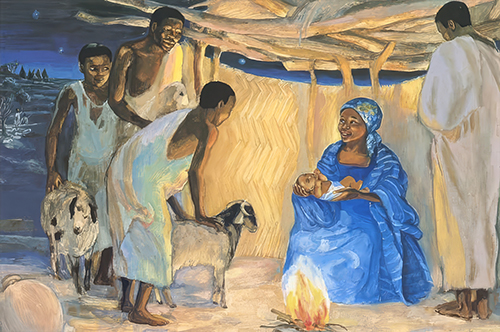
The image I have chosen, celebrating Christmas day, is a painting titled, “The Birth of Jesus with Shepherds” from the “Vie de Jesus Mafa” (Life of Jesus Mafa) series.
The pride and delight on Mary’s face is infectious. Her smile is contagious and invitational; “Look at my boy” she exclaims to whoever wants to see!
About the Image
Vie de Jesus Mafa (Life of Jesus Mafa) was an initiative undertaken in the 1970s to help teach the gospel in Northern Cameroon. French Catholic missionary François Vidil worked with Mafa Christian communities in Cameroon to create a catalogue of 70 paintings depicting the life of Jesus as an African man. The plan was to build a resource that would help Mafa people to teach from the Bible in a way that connects with their community.
As in the stained-glass windows in the European medieval cathedrals, where the environment and characters shown belong to the medieval society, likewise in Jesus Mafa paintings the characters and the environment belong to Africa. This visual support of everyday life helps the African believer as they present the gospels orally.
Vidil formed a team of local church leaders, theologians and carefully selected artists. The team would spend time in Mafa communities, reading Bible passages and getting people to reenact them. Vidil and his team would photograph their reenactments as the artist sketched them. These sketches and photographs became the basis of the final paintings in this collection.
More images from this collection are available at Vanderbilt University Divinity Library, USA.