
What is special about the Third Sunday of Advent? For much of the Church’s history, this Sunday had a special name: “Gaudete” Sunday.
“Gaudete” means rejoice.
The traditions surrounding this Sunday go back as far as the fourth or fifth century, as does the season of Advent itself.
Advent, our preparation for Christmas, was originally a forty-day penitential season like Lent. In fact, since it used to begin on November 12 (just after the Memorial of St. Martin of Tours), it was called “St. Martin’s Lent.” “Gaudete Sunday” was the Advent counterpart to “Laetare Sunday,” which marks the mid-point in Lent.
On Gaudete Sunday, the season of Advent shifts its focus. For the first two weeks of Advent, the focus can be summed up in the phrase, “The Lord is coming.” But beginning with Gaudete Sunday, the summary might be, “The Lord is near.” This shift is marked by a lighter mood and a heightened sense of joyous anticipation.
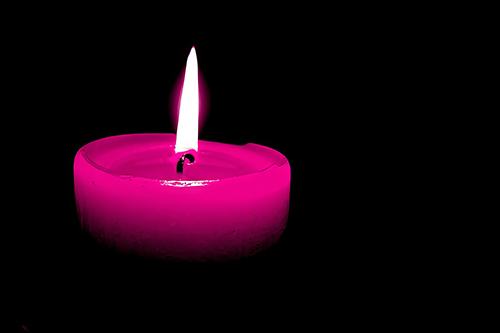
Liturgically, the colours lighten as well. The priest usually wears rose-coloured vestments, a hue seen only on Gaudete Sunday and Laetare Sunday. On this day, we light the third candle of the Advent wreath, which is also rose-coloured, or if you prefer, pink.
But lighting candles in Advent is more than liturgical tradition—it’s an act of prophetic hope, as one powerful example demonstrates.
In South Africa, in the face of racial injustice, people of faith began to pray together and, as a sign of their hope that one day the evil of apartheid would be overcome, they lit candles and placed them in their windows so that their neighbours, the government, and the whole world would see their belief.
And their government did see. They passed a law making it illegal, a politically subversive act, to light a candle and put it in your window. It was seen as a crime, as serious as owning and flaunting a gun.
The irony of this wasn’t missed by the children. At the height of the struggle against apartheid, the children of Soweto had a joke: “Our government,” they said, “is afraid of lit candles!”
It had reason to be. Eventually those burning candles, and the prayer and hope behind them, changed the wind in South Africa. Morally shamed by its own people, the government conceded that apartheid was wrong and dismantled it without a war, defeated by hope, brought down by lit candles backed by prayer.
Hope had changed the wind.
During the season of Advent, Christians are asked to light candles as a sign of hope. Unfortunately, this practice, ritualized in the lighting of the candles in the advent wreath, has in recent years been seen too much simply as piety (not that piety doesn’t have its own virtues, especially the virtue of nurturing hope inside our children).
But lighting a candle in hope is not just a pious, religious act; it’s a political act, a subversive one, and a prophetic one, as dangerous as brandishing a firearm.
To light an advent candle is to say, in the face of all that suggests the contrary, that God is still alive, still Lord of this world, and, because of that, all will be well. This is true irrespective of the evening news.