Directly opposite St. Patrick’s Cathedral on Fifth Avenue in New York City there is a bronze sculpture of the mythological Greek god called Atlas. Installed in 1937, the sculpture is some 45ft tall and, like many other sculptures of Atlas he appears to have the weight of the world on his shoulders.
The oldest extant statue of Atlas is known as the Farnese Atlas dating from around the 2nd century AD. The sculpture is currently located at the National Archaeological Museum in Naples, Italy.
In the original Greek, Atlas isn’t holding up the world at all, he’s holding up the sky. There is nothing like taking a little (or somewhat heavy) license when creating a sculpture is concerned
Atlas with the weight of the world on his shoulders.
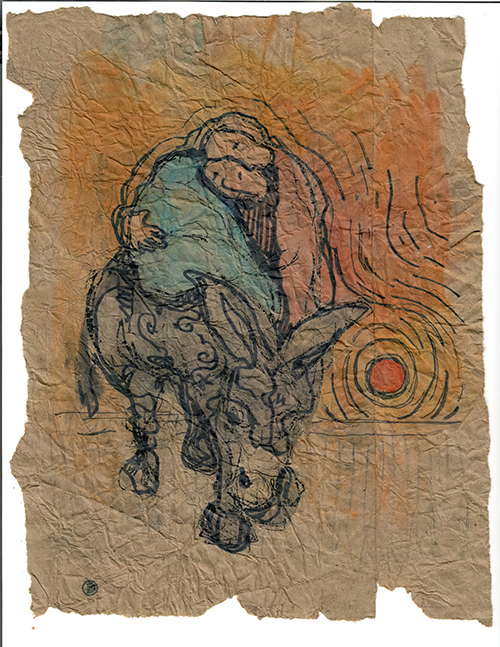
Daniel Bonnell is a noted published artist whose work is found around the world, in churches, cathedrals, and private collections.
One of his artworks it titled “The Weight of the Word”.
It might well suggest that it is no easy ride being The Word Made Flesh, and it is no easy responsibility carrying that Word.
In Orthodox Christianity there has been, since the 4th century a word used to describe Mary. The Greek word is ‘theotokos’, a word meaning “God-bearer”.
Today, in our liturgy, we have another God-bearer – the donkey which Jesus rides into the city of Jerusalem (Mtt. 21:1 – 11)
As baptised women, men and children we are called to be “theotokos” – to bear Christ into the environment I call home, to my place of work, my place of socializing and recreation. Dare to become a donkey and carry the “weight of the Word” wherever.
This Sunday’s Gospel (Jn. 11:1–45) is considerably long – it is the story of the death and raising to life of Lazarus, the brother of Martha and Mary.
Proclaiming the story offers its own challenges. Standing and listening, I would well imagine, offers considerably more!
Elements of the story that have given me cause for reflection.
Firstly, the story is recounted only in the Gospel of St John. I would have thought such an astonishing event would have been recorded everywhere.
Today, such a miracle would have been front-page news on TikTok, Instagram, Facebook, and media outlets worldwide! Why the silence on the part of Matthew, Mark, and Luke?
Secondly, while the story itself is long, we could compress it to one sentence – in fact, two words: “Jesus wept.”
While the story is indeed about Lazarus, it also affords an opportunity to reflect on the response of Jesus. “Where have you laid him?” is his enquiry, and when shown the sight, the immediate, spontaneous response of Jesus is tears.
Tears are an integral part of our being human. They come as a response to joy, happiness, delight, wonder, and awe. They come too as a response to deflation, disappointment, sadness, pain, and grief.
Tears are an important part of the human person’s communication system. When vocabulary seems at a loss to express the feeling quality associated with an occasion or a person, the language of emotion takes over.
Tears communicate all manner of feeling – as our Gospel story affirms: “So the Jews said, ‘See how he loved him!’ “
The third point for reflection is that all this happened in public. Jesus’ grief was overt, available for all to see. He was a Jewish man exhibiting his Jewishness.
As mature Pākehā we are more inclined – though not all of us – to weep in private. Consider the number of films you have watched where an adult begins to weep, grabs a tissue, and hurries from the room.
One of the after-effects of a stroke is that people often experience emotional and behavioural changes. The reason is straightforward: stroke impacts the brain, and the brain controls our behaviour and emotions.
As a consequence, a person may be sitting watching a TV programme or listening to music, and quite spontaneously tears well up and roll down their cheeks – inevitably, with others in the room.
The final point for reflection is the request of Jesus: “Unbind him, let him go free.” This request was given to those gathered at the burial site.
Hold on a moment. I don’t mind standing at the place of burial. I don’t mind shedding a private tear or two. But getting that up close and personal? “Unbind him, let him go free.” Ultimately, another person’s freedom arrives when I unbind them.
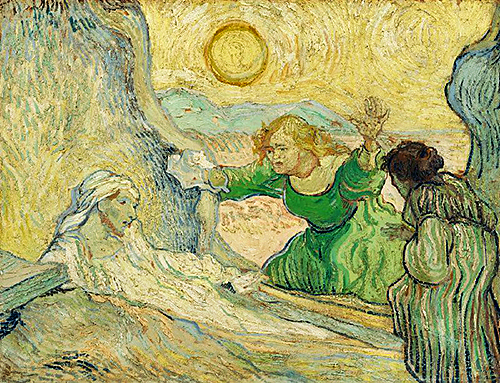
Prints from other masters inspired Van Gogh during his stay at the hospital in Saint-Rémy. He made his version of the Raising of Lazarus from an etching by Rembrandt (1642). With his ginger beard, Lazarus bears some resemblance to Van Gogh himself.
The painter may have seen a parallel between Lazarus’ return from the dead and his own struggle from mental illness towards recovery.
Art critics note that Van Gogh’s depiction left out the central figure of Christ with his arm raised, as is very evident in Rembrandt’s painting. Or did he? Notice – the sun/Son is shining.
Consider, too, the colour of each painting. Van Gogh painted with the vibrancy of light; Rembrandt is dark and sombre.
Possibly, the vibrancy of light in the Van Gogh painting represents the new life of Christ experienced by Lazarus.
“Our story begins in darkness: ‘the earth was a formless void, and darkness covered the face of the deep.'” (Genesis 1:2)
The Gospel of John ends in darkness: “‘I’m going out to fish,’ Simon Peter told them, and they said, ‘We’ll go with you.’ So they went out and got into the boat, but that night they caught nothing.” (John 21:3)
Out of the darkness a voice is heard: “Let there be light, and there was light.” (Genesis 1:3)
As night gives way to dawn, a voice is heard from alongside the charcoal fire: “Come and have breakfast.” (John 21:12)
In the Gospel for this Sunday, we read of a man who had been blind from birth. (John 9:1)
Again, a voice is heard: “Go and wash in the pool of Siloam” (John 9:7) — and “the blind man went off and washed himself and came away with his sight restored.” (John 9:6)
I cannot recall from personal experience; however, my understanding is that although it is dark inside the womb, human skin does allow light to pass through and provide some illumination for the developing foetus.
The American poet Wendell Berry wrote a poem titled “To Know the Dark”:
To go in the dark with a light is to know the light.To know the dark, go dark. Go without sight,and find that the dark, too, blooms and sings,and is travelled by dark feet and dark wings.
There is a small book read by many yet understood by few: The Little Prince by Antoine de Saint-Exupéry.
In the book, a pilot is stranded in the midst of the Sahara, where he meets a tiny prince from another world travelling the universe in order to understand life.
One of the book’s most memorable lines — spoken by the fox — has stayed with me for years: “It is only with the heart that one can see rightly; what is essential is invisible to the human eye.”
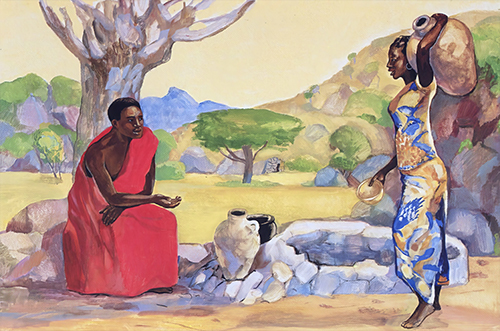
The Woman at the Well, recounts the encounter between Jesus and the Samaritan woman.
It has been painted often, written about at length, and preached with frequency.
It reminds me of a dishcloth in the kitchen — much used and wrung dry countless times. The more words written and spoken, the more the reality becomes hidden beneath them.
Each author or preacher attempts to find some new and enlightening angle.
Many focus on Jesus as he shatters the taboos of his time — and ours. Gender discrimination, ritual purity (sharing a drinking cup with a Samaritan), socio-economic poverty (any woman married five times was likely poor), religious hostility, and the moral stigma of serial marriages.
And yet the woman is left nameless. She is not alone in this Gospel ignominy — but how would you feel, being spoken of without a name?
Here is a picture to sit with. It comes from Vie de Jésus Mafa (Life of Jesus Mafa), a series of paintings undertaken in the 1970s to help teach the Gospel in northern Cameroon.
Notice the grace of the woman. The way she carries herself. Her elegant walk.
Our Gospels, by tradition, were written by men. Have you ever considered how these stories might read if written by women?
This Sunday, be bold. Sit with this woman and let her tell her story.