1st Sunday in Lent

The image shows green grass growing in parts of Kulnura on the Central Coast of New South Wales, which had been burned three weeks earlier. The photograph was taken in 2022.

Lent is here again.

Retreat for a moment to your childhood memories. Sweets gathering in an Agee jar in the cupboard. Fasting and abstinence to the fore. Self-restraint in all things the order of the day.

No meat on Fridays. The strong determination to do something more worthwhile.

My strongest memory is that I have always celebrated my birthday during Lent! Why did my parents choose early March as my birth date?

The image I have for the season of Lent is living with the blinds pulled down. The word subdued comes to mind. Sackcloth would be the Old Testament equivalent.

There are, however, some anomalies in our season of Lent.

The first is in the “liturgical sackcloth” we use. Our Lenten liturgical colour is purple, the same colour used most frequently during our ritual for the dead.

In antiquity, purple was one of the most challenging colours to produce, making it highly prized and often reserved for the elite. The most famous purple dye, Tyrian purple, was derived from the mucous secretion of sea snails, particularly the Murex brandaris.

This painstaking process required thousands of snails to produce just a small amount of dye, contributing to its high value and association with nobility and power. The Roman emperors famously donned purple togas, symbolising their supreme status.

The rare and expensive Tyrian dye of antiquity is now widely available through synthetic pigments developed in the 19th century. To this day, purple remains associated with royalty, wealth and power.

If in doubt, search images of King Charles III and Queen Camilla waving to the gathered crowd immediately following his coronation. After the ceremony at Westminster Abbey, Charles retired to a side room and changed into a specially made purple satin coronation tunic.

The second anomaly is the very word itself — Lent. It originates from the Old English word “lencten,” meaning spring.

Spring is the season of new budding and new growth. It is the season of fresh colour, of awakening, of new lambs and calves, of daffodils and tulips.

The world is anything but subdued. The world is noisy with new life.

The third anomaly is our use of ashes. If you participated in the Ash Wednesday liturgy, you may have noticed that the usual Penitential Rite was omitted and replaced by the blessing and giving of ashes.

This gives the ashes a penitential feel. However, ashes are, in fact, anything but penitential.

Wood ash provides potassium and lime — essential elements for healthy growth. This is most evident in the new growth that follows a forest fire, where new shoots push up through the ash, which becomes the seedbed for renewal.

May the ashes of Ash Wednesday be the seedbed of new growth in you.
5th Sunday of Lent

This Sunday’s Gospel is considerably long – it is the story of the death and raising to life of Lazarus, the brother of Martha and Mary. Proclaiming the story offers its own challenges, standing and listening I would well imagine offers considerably more!

Did you know Lazarus has his own website? For those with the slightest interest it  “is a Delphi compatible cross-platform IDE for Rapid Application Development. It has variety of components ready for use and a graphical form designer to easily create complex graphical user interfaces.” I have absolutely no idea what any of that means!!

However, back to our Gospel.

Elements of the story that have given me cause for reflection.

Firstly, the story is recounted only in the Gospel of St. John. I would have thought such an astonishing event would have been recorded ‘everywhere’. Today, such a miracle would have been front page news on Tik Tok, Instagram, Facebook, and media outlets worldwide! Why the silence on the part of Matthew, Mark, and Luke?

Secondly, while the story itself is long, maybe we could well compress the story to one sentence, and in fact two words – “Jesus wept”. While the story is indeed about Lazarus, it also affords me the opportunity to reflect on the response of Jesus. “Where have you laid him?” is the enquiry of Jesus, and when shown the sight, the immediate, spontaneous, response of Jesus is one of tears.

Tears are an integral part of our being human; they come as a response to joy, to happiness, to delight, to wonder, to awe. They come too as a response to deflation, to disappointment, to sadness, to pain, and to grief.

Tears are in fact an important part of the human persons  communication system – when the human vocabulary seems at a loss to express the feeling quality associated with an occasion or a person, the vocabulary of emotion takes over. Tears communicate all manner of feeling. This is communicated again in our Gospel story, “so the Jews said, ‘see how he loved him!’ “.

The third reflective point for myself is that all this happened in public! Jesus’ grief was overt, available for all to see! He was in fact a Jewish man exhibiting his Jewishness! As ‘mature’ Caucasians we are more inclined (though not all of us) to weep in private. Consider the number of movies you have watched where an adult begins to weep, grabs a hanky or a tissue and hurries from the room!

One of the after-effects of a stroke is that persons often experience emotional and behavioural changes. The reason is simple. Stroke impacts the brain, and the brain controls our behaviour and emotions. As a consequence, a person may well be sitting watching a TV programme, or listening to a piece of music, and quite spontaneously tears well up and roll down the cheeks (and inevitably there are others in the room!).

The final reflection point for myself is the request of Jesus, “unbind him, let him go free.” This request is given to those who had gathered at the burial site. Hold on a moment! I don’t mind standing at the place of burial! I don’t mind shedding a ‘private’ tear or two! However, getting that up close and personal?? “Unbind him, let him go free.” Ultimately, the individual’s freedom arrives when I unbind them!

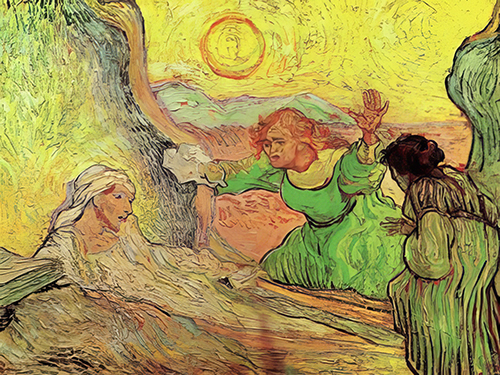
Prints from other masters inspired Van Gogh during his stay at the hospital in Saint-Rémy, and he made his version of the Raising of Lazarus from an etching by Rembrandt (1642). With his ginger beard, Lazarus bears some resemblance to Van Gogh himself.

The painter may have seen a parallel between Lazarus’ return from the dead and his struggle from mental illness towards recovery.

Art critics note that Van Gogh’s depiction left out the central figure of Christ with his arm raised as is very evident in the painting by Rembrandt.

Note, however, the colour of each painting; for myself, Van Gogh has painted with the vibrancy of light. Rembrandt is dark and sombre. Possibly, the vibrancy of light in the Van Gogh painting is the new life of Christ experienced by Lazarus!

4th Sunday of Lent

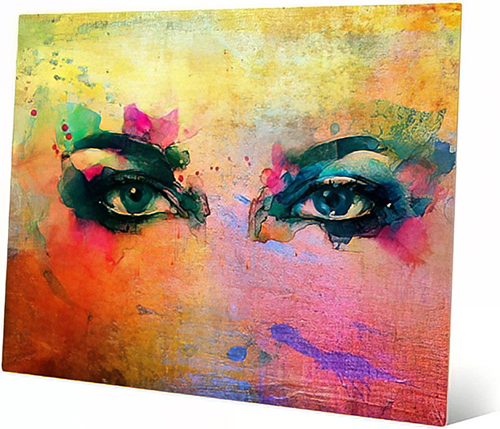
The illustration is a contemporary modern watercolour with the title, “Eyes Gazing”

When I was living and in ministry in the city of Christchurch I had the use of a small car to get me from A to B and on occasions even as far as O and P!

The car was nifty and ran well and being small was easy to park.

However, as the driver, I noticed the car had a blind spot!

The framework of the chassis which held the left front window in place prevented me, as the driver, with a clear vision, from looking for oncoming motorists, cyclists and indeed pedestrians.

I found myself becoming concerned and frustrated.

Eventually, I took the vehicle to the dealership and explained what I considered a major manufacturing fault.

The gentleman listened attentively, and then we went and examined the vehicle.

To my surprise ( and chagrin), the gentleman sat in the driver’s seat, moved the seat forward a little and suggested I myself take the seat, and as it says quite simply in this Sunday’s Gospel, “ he was able to see!” ( Jn 9:7).

This Sunday, the Gospel is the story of a blind man receiving his sight.

The story in the Gospel involves spittle, dust from the ground forming a paste, washing in the pool of Siloam, a testy encounter with the Pharisees, and indeed disbelief.

All I needed to do was make a small adjustment to my sitting position!

However, while it was easily managed in the motor vehicle, in life, the shift maybe a little more difficult.

Where I sit and/or stand gives me a certain viewpoint; however, it may also provide a “blind spot”.

A blind spot is an obscuration of the visual field.

One could get all technical; however, from a medical point of view, it concerns the lack of light-detecting cells.

Perhaps from a Christian living viewpoint (or lack of!) if I sit or stand in the same place, I may in fact be preventing the light from penetrating, thus promoting a “blind spot”.

At the end of the Gospel, Jesus says, “ I came into this world, so that those who do not see, may see.” (Jn 9:39)

The illustration is a contemporary modern watercolour with the title, “Eyes Gazing”