Feast of St John Lateran

This Sunday, the Church celebrates a church—though not just any church.
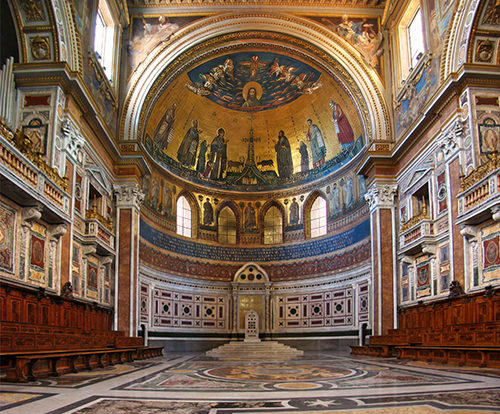
Situated on the outskirts of ancient Rome along the still-visible Aurelian Walls is the Archbasilica of St John Lateran, the cathedral of Rome.

Dedicated to Christ the Saviour in 324, St John Lateran was later placed under the additional patronage of St John the Baptist and St John the Evangelist. Its formal name is the Papal Archbasilica of the Most Holy Saviour and Saints John the Baptist and John the Evangelist at the Lateran. (“Lateran” refers to its location on a hill that was formerly the Roman estate of the Laterani family.)

St John Lateran was the site of the pope’s residence for nearly 1,000 years, five of the Church’s ecumenical councils, and the signing of the pivotal 1929 treaty between Italy and the Holy See.

On either side of the central nave stand colossal sculptures of the twelve apostles. The statue of St Matthew shows him with one foot on a fallen bag of coins—almost a stance of rejecting what once gave him status, in favour of something new.

Halfway down the nave is the statue of St Thomas, his finger protruding from the niche and pointing to the altar. The placement is strategic: from one angle, all you see is a finger pointing. On our pilgrim journey there can be moments of doubt and disillusion; and there is St Thomas, with the most famous finger in the Gospels, pointing us in the right direction.
26th Sunday of Ordinary Time

A wandering monk came to a village.

He was about to settle down under a tree for the night when a villager came running to him and said, ‘Give me the precious stone.’

‘What stone are you talking about?’ asked the monk.

‘Last night I had a dream’, said the villager, ‘that if I went to the outskirts of the village at dusk, I would find a monk who would give me a precious stone that would make me rich forever.’

The monk rummaged in his sack, found a stone and took it out. ‘This is probably the stone you are talking about,’ he said, as he handed it to the villager. ‘I found it in the forest a few days ago. You are welcome to it.’

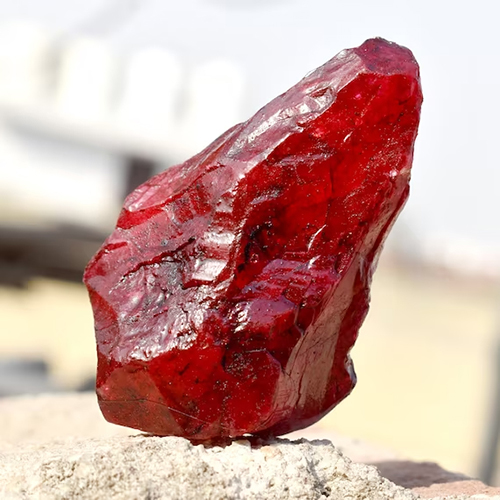
The villager took the stone and gazed at it in wonder. It was a beautifully red ruby, the largest he had ever seen.

He took it home with him.

All night he tossed about in his bed, unable to sleep.

Early next day he went back to the outskirts of the village and found the monk.

He said to him, ‘During the night I was unable to sleep, and I have done a lot of thinking. You can have the precious stone back.

Instead, give me the kind of wealth that makes it possible for you to give this ruby away so easily.’

The richer a person’s inner life is, the simpler becomes their outer life – the less they need or want.

Palm Sunday

Murder on the Orient Express is a work of detective fiction by English writer Agatha Christie featuring the Belgian detective Hercule Poirot. The book was first published in January 1934.

There have been four film adaptations.

The 2017 screen adaptation featured such well-known names as Judi Dench, Kenneth Branagh and Johnny Depp.

The film begins with a young boy running helter-skelter through an awakening city. The boy carries a collection of chicken eggs for the chef to choose two.

The eggs are boiled and presented to Monsieur Hercules Poirot for his breakfast.

The young boy is not seen again, most of the film happening on a train. In the cast credits, he is simply named a ‘young boy. ‘

Like many others, known as ‘extras’ their presence is necessary for the film to be produced.

They are known as ‘uncredited’

When one reads the entire cast, one is faced with the fact that there at least 59 uncredited persons were in the cast!

They are necessary to the film, so necessary that nobody notices.

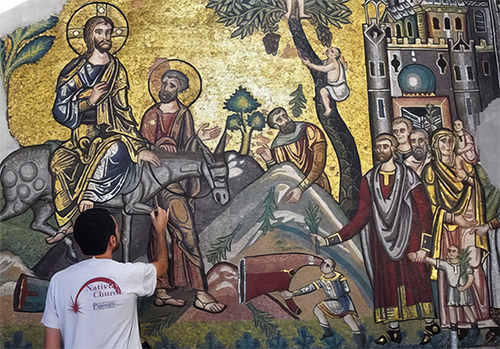
The illustration is of a mosaic of the entry of Jesus into Jerusalem. The mosaic is found in the Church of the Nativity in Bethlehem. Since 2013, Italian restorationists have been working in a mammoth effort to restore the mosaics present in the Church. Mosaics in the Church date back to the 4thC, AD.

Today, in our liturgy for Palm Sunday, I invite you to notice an ‘uncredited’ cast member – the donkey!

“Jesus found a young donkey and sat on it . . . .” (Jn. 12:14)

All four of the Gospels record the same event, (Lk. 19: 35, Mt. 21:7, Mk. 11:7).

It is not the first occasion Jesus has been on a donkey!

While there is no Scriptural evidence, I invite you to cast your mind back to those Christmas cards you send and receive each year.

Many include a portrait of Mary and Joseph making the journey to Bethlehem and Mary is sitting astride a donkey. And Mary is pregnant.

The Gospel of Matthew also tells the story of the Holy Family’s flight into Egypt (Mt. 2: 13- 23).

Again, without Scriptural evidence, artists throughout the generations have pictured this ‘flight’ with Mary and the newborn Jesus sitting on a donkey and being led by Joseph.

Uncredited and yet essential – the donkey!

The one who carries the Word made flesh!

As companions of Jesus, that is our call also – to be uncredited and yet essential carriers of the Word!

5th Sunday of Lent

Pope Francis visited Brazil from the 22 – 29 July 2013.

While returning to Rome aboard the papal plane, Pope Francis engaged in a remarkable candid dialogue with journalists.

He took questions from reporters traveling aboard the papal plane for a full hour and 21 minutes with no filters or limits and nothing off the record.

Pope Francis stood for the entire time, answering without notes and never refusing to take a question.

The final query was an incredibly delicate one about charges of homosexual conduct against his recently appointed delegate to reform the Vatican bank, and not only did Francis answer, but he thanked reporters for the question.

The Pope’s response reverberated throughout the whole world.

People rubbed their ears and asked themselves or others, ‘Did I hear right?’

Pope Francis words were, “Who am I to judge them if they’re seeking the Lord in good faith?” “Who am I to judge them?”

Today’s Gospel (Jn. 8:1 -11) is prefaced in the Gospel I use with the heading, ‘The Woman Caught in Adultery’, and every Bible I could lay my hands on at the time had the same heading!

However, let us be clear about one important point right from the start: this story is not about adultery!

When we know something of the culture in which Jesus lived, our understanding is broadened.

At the time of Jesus, men were allowed multiple wives, and women were regarded as property.

This story is about retaining ‘my property’.

In our world and social norms, we regard adultery as sexual almost exclusively.

In the culture of Jesus, it is about property rights!

This Gospel is not about adultery!

It is about men, using, judging and condemning women.

Little of that has changed!

This Gospel is not about adultery!

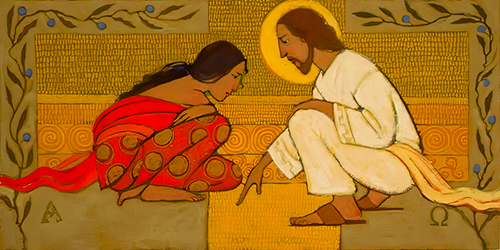
It is about finger-pointing, and, as I have said more than once, “to point a finger at another one needs to point three at oneself.”

“Let anyone without sin cast the first stone.”

We read of a gospel riddled with the unacceptable, the suspect, the devious and the weak — for the lepers and the Samaritans and the women.

We read of Jesus with thieves, of Jesus with tax collectors, of Jesus with sinners.

“Who am I to judge?”

“Let anyone without sin cast the first stone!”