Fourth Sunday of Easter

I live in a country where there are 4.5 sheep to every person. Therefore, gospel talk about sheep, shepherds, and sheep gates needs to be taken with a grain of salt.

Today is known as ‘Good Shepherd Sunday’, and each year the gospel reading focuses on some aspect of Jesus as the Good Shepherd.

This year (Year A) it is “I am the gate of the sheepfold” (Jn 10:1–10). Year B: “The good shepherd lays down his life for his sheep” (Jn 10:11–18). Year C: “My sheep hear my voice … I give them eternal life, and they shall never perish” (Jn 10:27–30).

Today Jesus describes himself as a “gate” – try putting that on your CV when applying for a job!

Wikipedia informs us that “gates” may prevent or control the entry or exit of individuals, or they may be merely decorative.

In first-century Palestine, sheep depended completely on their shepherds to care for their needs and lead them to safe pastures. At night, they slept in sheepfolds.

Often the shepherds and their flocks slept out in the countryside, where the sheep pens were made of loosely stacked rocks. These pens had no gate, only a small opening through which the shepherd guided the sheep.

The shepherd then lay down and slept in this opening. Any thief or predator would have to climb over him to gain entrance. In this way, the shepherd became the gate for the sheep – offering both access and protection.

The shepherds literally became the gate to the sheep pen.

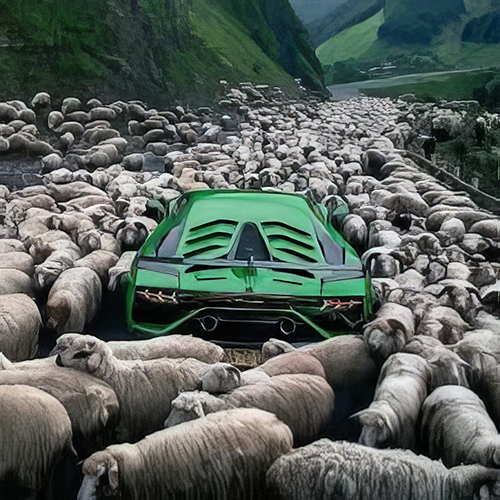
I invite you to look closely at today’s image. It is called a “sheep gate”. No matter how fast the car is, nor how much it cost to buy, sheep can bring it to a halt.

No matter how big or sophisticated we consider ourselves to be, nor how much money we hold in our bank account, wander into the presence of Jesus and we will be caught. And, like our Lamborghini, we will be forced to wait and wait …

You did notice that a “sheep gate” can corral a Lamb-orghini as well!
Third Sunday of Easter

The Curse of Oak Island is a television series following a group of people endeavouring to locate some presumed ancient treasure, supposedly hidden by the Aztecs.

To date, the group has bored holes many feet into the earth and drained a swamp. A metallurgist has walked the island with a metal detector, searching for any material that may give the group a sense of where best to concentrate their efforts.

On a recent programme, one of the team, at the end of a fruitless day, exclaimed, “The journey is the treasure.”

Our Gospel for this Sunday is the familiar story from Luke, commonly known as “The Walk to Emmaus” — Emmaus being a village some seven miles from Jerusalem (Lk 24:13–35).

On a trip to the Holy Land, you can visit all kinds of places. You can visit the Church of the Nativity, the site of Christ’s birth in Bethlehem. You can pray in the Garden of Gethsemane in Jerusalem and attend Mass on Mount Calvary in the Church of the Holy Sepulchre.

You can pray at the site of the Lord’s Ascension or kneel in Nazareth at the place of the Annunciation. All in all, pilgrims can pray at the sites of all the mysteries of the rosary — save the Coronation.

One place you may not visit, however, is the town of Emmaus.

Search as you might, the location of the village in today’s Gospel has been lost to history. Several sites over many years have been suggested.

While our Gospel tells us the town was seven miles from Jerusalem, the writer does not tell us in which direction to start walking — north, south, east, or west.

Maybe that is the whole point of the story: the walk, not the arrival.

“Are we there yet?” Don’t be in such a hurry — the journey is just as important.

Then we might well notice our hearts burning within us. The recognition will happen not at the end, but while on the journey.

We will not have to wait until we are sitting at table. The recognition has come through a shared walk and a shared storytelling.

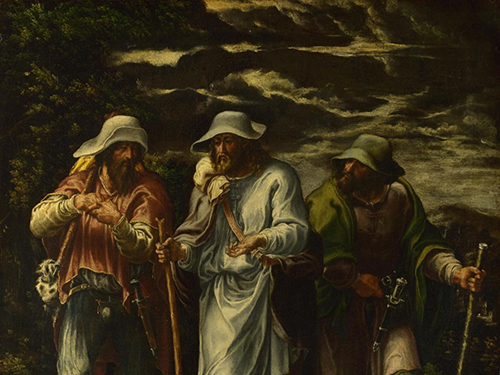
The painting is by the Italian Lelio Orsi (1511–1587). Titled “The Walk to Emmaus,” it is part of the collection of the National Gallery, London.

Seconday Sunday of Easter

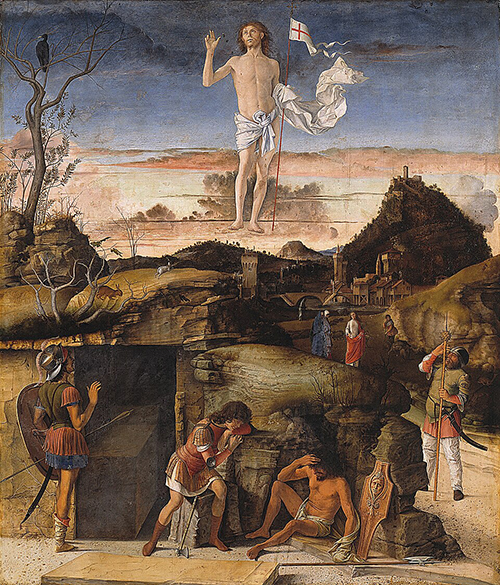
A perusal of Western religious art depicting the Resurrection of Jesus reveals a consistent pattern — Jesus is painted as going out and up. Some works indeed almost mirror the Ascension.

The art of the Orthodox tradition of Christian spirituality is the opposite. Within frescos and mosaics, the movement of Jesus is downward.

Within the Apostles’ Creed we pray that truth: “He suffered under Pontius Pilate, was crucified, died, and was buried; he descended to hell. The third day he rose again from the dead.”

One of the most famous depictions of this “downward” movement is the Anastasis, painted in the apse of the funeral chapel of the Church of the Holy Saviour (usually known simply as Chora) in present-day Istanbul.

First built in the 4th century, the Chora Church has been transformed through history into different functions, adapting to the political climate of Istanbul.

At the centre of the fresco stands a radiant, resurrected Christ. He stands on two broken gates of hell, with keys and locks festooned about them.

Flanking Christ are two sarcophagi, from which he draws Adam and Eve. He extends his hand in grace, pulling them — and by extension all of humanity — from the tomb.

On this second Sunday of Easter, known as Divine Mercy Sunday, the fresco from the church at Chora may provide a meditation around the theme: “I will come to you in your place of need and lift you out of that place.” Does that sound like mercy at all?

Resurrection of Christ is a painting by the Italian Renaissance artist Giovanni Bellini and is held at the Gemäldegalerie, Berlin.

The Anastasis fresco is part of a number of frescos found in the Church of the Holy Saviour at Chora, Istanbul.

Easter Sunday

To know that the author JRR Tolkien was a devout Catholic changes the way we read his body of work. He himself acknowledged the influence his Catholic faith had on his writing.

In the third book of Tolkien’s Lord of the Rings trilogy, there is a scene that captures something of the joy experienced by the disciples when the resurrected Jesus appeared to them.

The realm of the Dark Lord, Sauron, has been destroyed, and against all hope the world has been saved, at least for the time being. Frodo, the hobbit, and his faithful servant and friend, Samwise, have also been saved.

Sam wakes up, smells wonderful perfumes and sees Gandalf, the wizard he thought was dead. Sam gasps, “Gandalf! I thought you were dead! But then I thought I was dead myself. Is everything sad going to come untrue?”

“A great Shadow has departed,” said Gandalf, and then he laughed, and the sound was like music, or like water in a parched land; and as he listened the thought came to Sam that he had not heard laughter, the pure sound of merriment, for days upon days without count. It fell upon his ears like the echo of all the joys he had ever known.

But he himself burst into tears. Then, as sweet rain will pass down a wind of spring and the sun will shine out the clearer, his tears ceased, and his laughter welled up, and laughing he sprang from his bed.

“How do you feel?” he cried. “Well, I don’t know how to say it. I feel, I feel” – he waved his arms in the air – “I feel like the spring after winter, and the sun on the leaves; and like trumpets and harps and all the songs I have ever heard!”