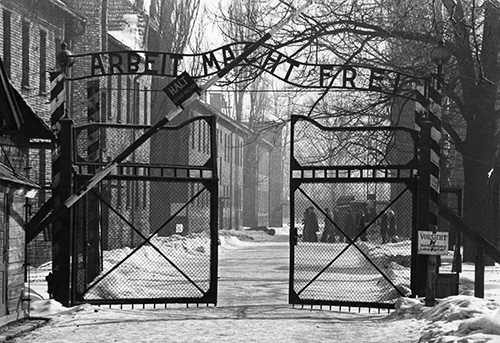
The illustration shows the gates of the Nazi concentration camp at Auschwitz, with the gate open.
We always begin Mass with what is known as the Penitential Rite. In this rite, we ask forgiveness for our sins.
As we do so, we should ask for the grace to forgive those who have sinned against us.
Today’s Gospel (Mt 18:21–35) has St Peter asking a question. The text reads: ‘Peter approached Jesus and asked him, “Lord, if my brother sins against me, how often must I forgive? As many as seven times?”‘ (18:21)
My first thought is: ‘If Peter needs to ask the question, he is not ready to forgive at all!’
A former inmate of a Nazi concentration camp was visiting a friend who had endured the same ordeal.
‘Have you forgiven the Nazis?’ he asked his friend.
‘Yes,’ came the reply.
‘Well, I haven’t. I am still consumed with hatred for them.’
‘In that case,’ said his friend gently, ‘they still have you in prison.’
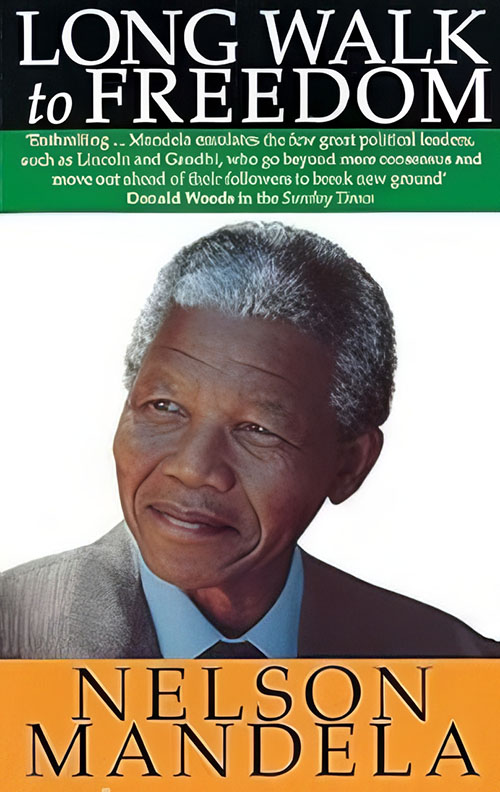
In his autobiography, Long Walk to Freedom, Nelson Mandela writes about his long years of imprisonment on Robben Island.
He recalls how, one day, he was called to the main office. Mandela had been chosen by the prisoners as their spokesperson.
General Steyn was visiting the island and wanted to know from Mandela whether the prisoners had any complaints.
Badenhorst, the officer in command of the prison, was also present. He was feared and hated by the prisoners.
In a calm, forceful and truthful manner, Mandela informed the visitor of the prisoners’ chief complaints, doing so without bitterness or recrimination.
The general duly noted what Mandela had to say, which amounted to a damning indictment of Badenhorst’s regime.
The following day, Badenhorst approached Mandela and said, “I am leaving the island. I just want to wish you people good luck.”
The remark left Mandela dumbfounded, and he thought about the incident for a long time afterwards. Badenhorst had perhaps been the most callous and barbaric commanding officer they had had on the island.
Yet the incident showed there was another side to his nature. As Mandela concludes: “It goes to show that even the most seemingly cold-blooded have a core of decency, and that if their hearts are touched, they are capable of changing.”
Reflecting on these words, and considering today’s Gospel from St Matthew (18:15–20) — which, in my Bible, follows the heading “Reproving Another Who Sins” — I am left thinking: it may not be so much what you say, but the way in which you say it, that matters.
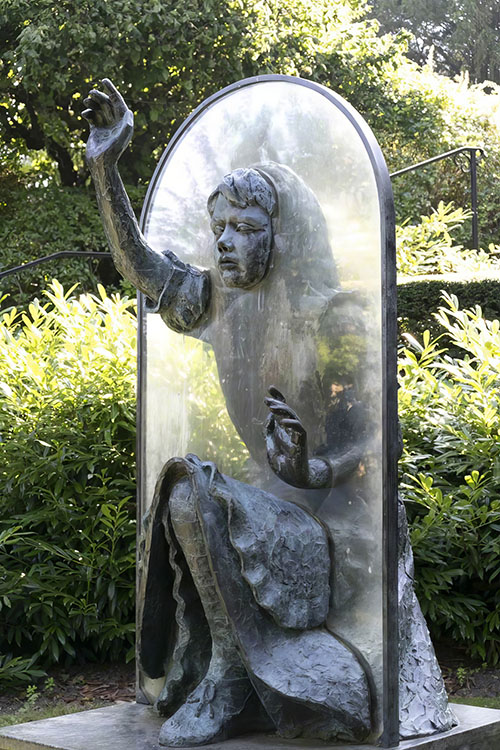
The illustration is by Jeanne Argent (1944–), a British sculptor, painter and printmaker best known for her 1990 bronze sculpture Alice Through the Looking Glass, located in the Castle Grounds of Guildford, Surrey.
Lewis Carroll, the English author, wrote a sequel to his much-admired novel Alice in Wonderland.
The sequel, titled Through the Looking-Glass, and What Alice Found There, sees Alice walk through a large mirror — the looking glass — only to discover that on the other side, life runs back-to-front.
Examples include:
Walking away from something brings you closer to it
Running helps you stay in the same place
You remember events and feel pain before the cause actually happens
Cake is shared by passing it around first and cutting it afterwards
To read the poem Jabberwocky, Alice needs to hold the text up to a mirror.
In today’s Gospel (Mt. 16: 21–27), Jesus, I suggest, is daring us to walk through the looking glass — to be audacious, and indeed courageous, enough to live back-to-front.
Jesus says:
“For those who want to save their life will lose it, and those who lose their life for my sake will find it. For what will it profit them if they gain the whole world but forfeit their life? Or what will they give in return for their life?”
P.S. Be cautious around full-length mirrors — who knows what might happen!
There is a television programme that airs before the weekday 6pm news bulletin on TV1.
The programme is called The Chase. It’s a quiz show with a difference: four contestants must pit their wits against the Chaser, a ruthless quiz genius determined to stop them winning the cash prize.
On occasion, both the contestant and the Chaser interrupt the quizmaster with an answer before the question has been fully read out. At times, that interruption causes blunders — an incorrect answer that could have been avoided had the contestant simply paused.
Admittedly, today’s Gospel (Mt 16:13–20) is not a quiz. However, it involves asking questions, and it is advantageous to wait until the end before answering.
Jesus first asks: “Who do people say that I am?” Those around him reach back into the history of the Jewish people and respond: John the Baptist, Elijah, Jeremiah and other prophets.
Jesus then turns to those he has lovingly invited into his community and patiently taught — those on whom the future of the mission depends — and asks: “Who do you say that I am?”
It is at this critical moment, between the question and the answer, that Jesus must wonder whether all he has shared with them has taken root.
This same question comes to each of us at some point in our own growth into spiritual maturity: “Who do you say I am?”
Do I, like those early disciples, reach back into my history and offer the answer given to me by my parents or caregivers, my teachers, or a religious leader?
Or do I dare provide an answer from the depths of my own inner self? This answer may well differ from that of those who first nurtured me in faith. However, it will be mine, and my relationship with Jesus will be founded on it.
To arrive at that answer, may I suggest we first need to be still and silent — to hear the whole question before we reply.
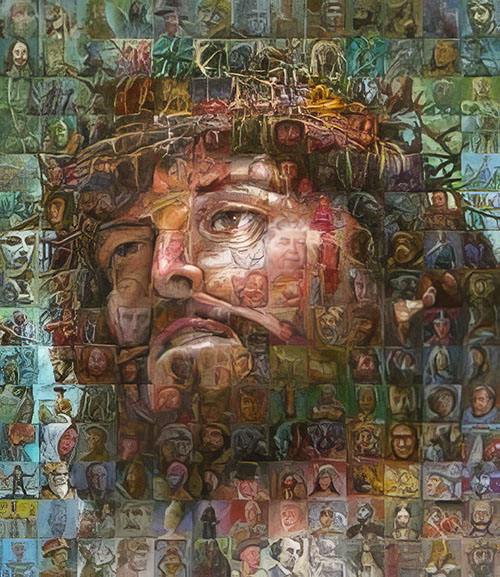
The image is a mosaic of the face of Jesus, constructed from a collage of many faces.