This past Tuesday, over morning tea, the conversation turned to what our Church calls evangelisation: the proclamation of the Gospel.
The word comes from the Greek euangelion, which translates literally as “glad tidings” or “good news”.
That good news is the Good News of the life, death and resurrection of Jesus the Christ – with the goal of inviting others to personal faith and discipleship.
The religious congregation these women belong to, the Josephite Sisters, has its origins in Australia.
Aboriginal and Torres Strait Islander peoples lived in Australia for at least 50,000 to 65,000 years before Europeans arrived. For those tens of thousands of years, they flourished without knowing the person of Jesus.
Similarly, the earliest human migrations from Southeast Asia reached parts of Oceania, including New Guinea, the Bismarck Archipelago and the Solomon Islands, between 50,000 and 30,000 years ago.
Again, these peoples lived full lives without any knowledge of Jesus.
Indigenous peoples had lived in the Americas for at least 23,000 to 25,000 years before major European contact began. They too lived credible and fruitful lives without knowing the person of Jesus.
And so I ask: do you have to know “about the life, death and resurrection of Jesus the Christ”?
From where most of us stand, I hear a resounding “yes”.
I need to come clean and state my point of view: I am not so sure.
I find myself asking whether the energy we call “evangelisation” is for the sake of others, or whether it is in fact for ourselves.
I also struggle with a historical truth. To “seed” the Christian faith in lands beyond Europe, those we called missionaries destroyed vibrant Indigenous faith practices.
In the Christian Church, we have just completed the Season of Creation. For years, Christians on six continents have kept it as an annual celebration of prayer and action for creation.
It is a time to renew our relationship with our Creator and with all creation through celebration, conversion and commitment together.
From the little I know of the Indigenous peoples of Australia, the Americas, the Pacific, Africa and indeed early Europe, they did not have to “organise” a season to celebrate creation.
Their rituals celebrated water, trees and other natural elements, giving praise to the Originator of them all!
Perhaps for Mission Sunday we could consider a different Greek word: ἀκούω (akouō), the ancient Greek for “listen” or “hear”.
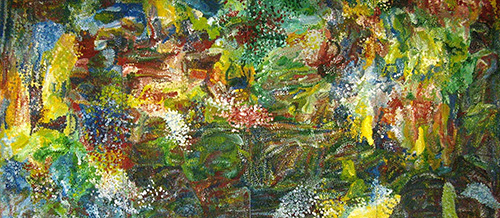
The illustration I have chosen is Earth’s Creation, an artwork by the late Indigenous artist Emily Kame Kngwarreye.
Kngwarreye (c. 1910–1996) was a senior Anmatyerre woman from the Utopia region of Central Australia. She is now recognised as one of Australia’s most celebrated Aboriginal artists.