In the Piazza del Campidoglio, Rome, there stands a bronze equestrian sculpture of the emperor Marcus Aurelius.
The French artist Jean Baptiste Mauzaisse painted Napoleon Bonaparte crossing the Alps on horseback.
Throughout history, rulers riding on horseback have been a universal symbol of power, military might, and elevated status. Whether leading troops into battle or parading through a captured city, the sight of a monarch mounted on a strong steed demonstrated dominance and commanded the attention of their subjects.
This imagery spans countless empires and cultures. It remains a deeply embedded archetype in art, literature, and religious traditions.
So why, then, does the author of the Book of Zechariah — which we read from in our First Reading (Zech. 9:9–10) — have the king riding on a donkey?
“See now, your king comes to you; he is victorious, he is triumphant, humble and riding on a donkey, on a colt, the foal of a donkey.”
In biblical times, a horse was primarily a warhorse. A king or military leader riding a horse conveyed a readiness for battle and the assertion of divine or royal authority.
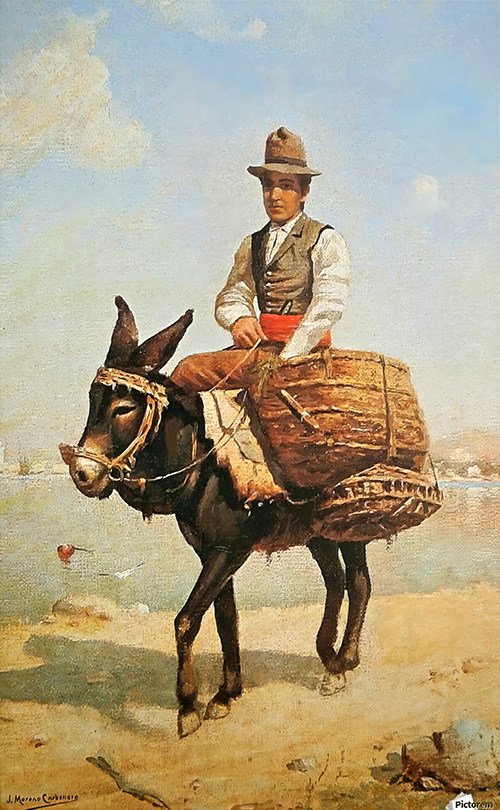
Conversely, riding a donkey or a mule symbolised a period of peace, humility, or a focus on civic duty rather than conquest.
When we read the passage from the Book of Zechariah, we note the many details symbolic of peace:
“Take away the chariots”: an end to the main vehicle of war.
“Take away . . . the war-horses”: no need for horses used in war.
“The battle bow will be broken”: no need for bows or arrows for fighting.
“He will proclaim peace to the nations”: his message will be one of reconciliation.
“His rule shall be from sea to sea”: the king will control extended territory with no enemies of concern (Zech. 9:10).
How different a picture to images of rows upon rows of armaments paraded in many capital cities.
The Moscow Victory Day Parade is an annual military parade of the Russian Armed Forces, held on Moscow’s Red Square on 9 May during the Victory Day celebrations. Horses have been replaced by tanks, missiles, and other armaments.
In Arlington, Virginia, and in Washington DC, a large military parade marked the United States’ Semiquincentennial celebrations. Again, horses were replaced by tanks and other armaments.
Here in New Zealand, we have our own military parade, known as Anzac Day. Horses have been replaced by wheelchairs, and other armaments by walking frames and crutches.
A final image to sit with: Jesus is in his local synagogue, sitting between his parents, when the synagogue official rises to his feet, unwraps the parchment, and begins, “A reading from the prophet Zechariah: ‘See, your king comes riding on a donkey . . .'”
The artwork is titled A Man Riding a Donkey by the Spanish painter José Moreno Carbonero (1858–1942).